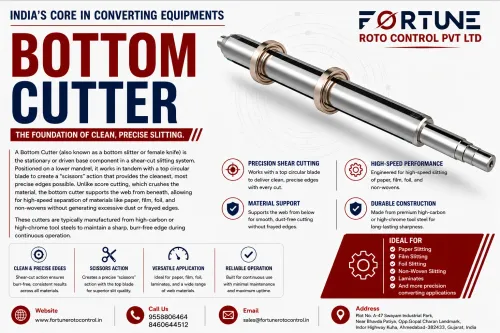
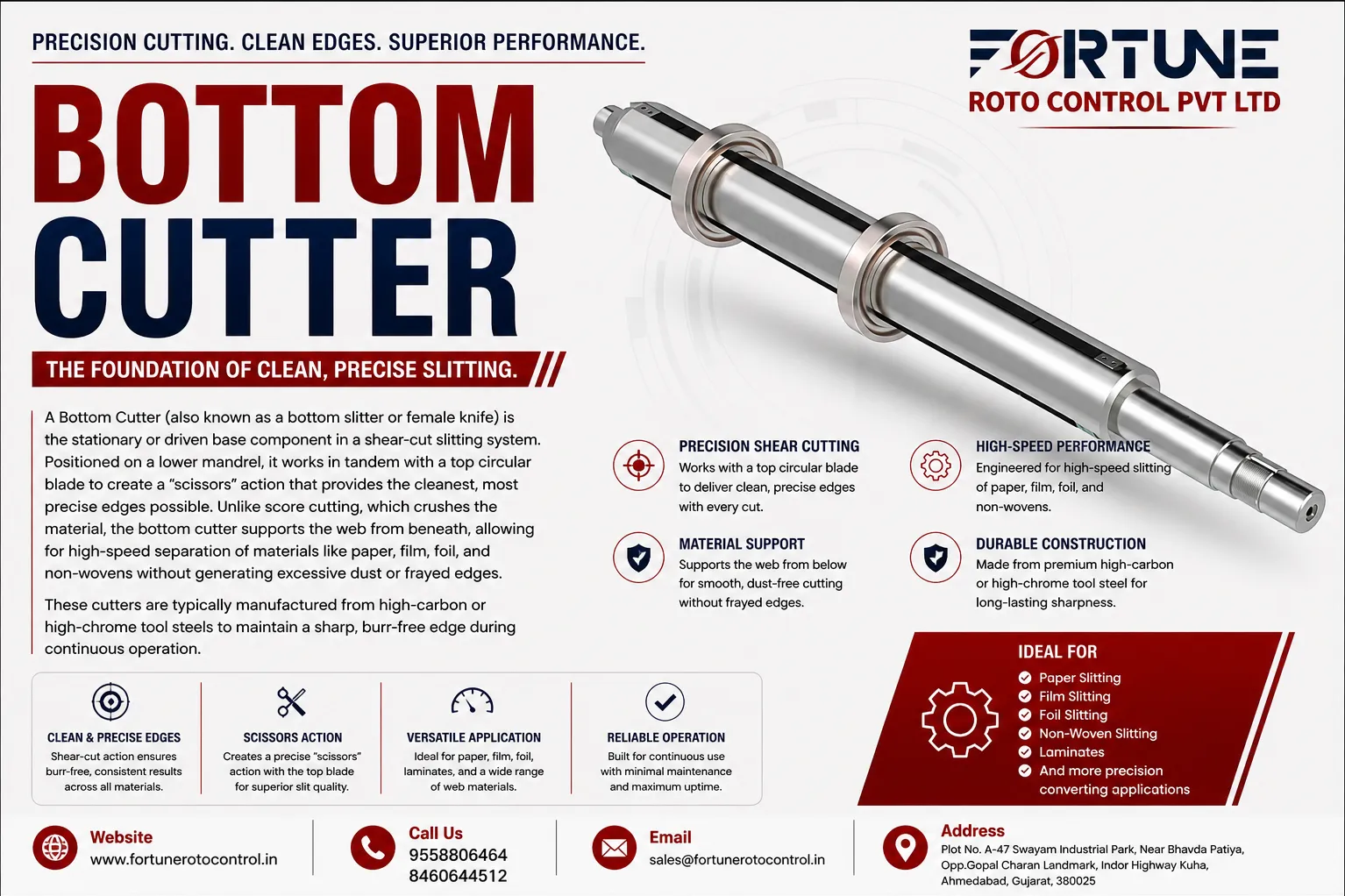
A Bottom Cutter is an essential component used in slitting machines to achieve clean and accurate cutting of materials during the slitting process. It works in combination with the top knife (or top cutter) and is mounted on the lower shaft of the machine. Industries like BOPP film, paper, foil, laminates, and flexible packaging rely on bottom cutters for precise slit quality.
The bottom cutter acts as the support or anvil against which the top blade performs the cutting action. Depending on the slitting method—such as shear cutting—the bottom knife rotates in synchronization with the top knife to create a sharp and consistent cut. The quality of the bottom cutter directly affects the edge finish, burr formation, and overall रोल quality.
In practical use, bottom cutters are designed for high wear resistance and long life, as they are continuously in contact with the cutting process. Proper alignment with the top knife is very important; even a small mismatch can lead to uneven cuts, dust generation, or damage to the material.
Operators prefer bottom cutters that are easy to set, stable during high-speed operation, and maintain sharpness over long production runs. They are commonly used in slitting lines for films, paper, aluminum foil, and other web materials where precision is critical.
Overall, a bottom cutter plays a key role in ensuring smooth slitting performance, clean edges, and consistent product quality in converting operations.
The bottom cutter acts as the support or anvil against which the top blade performs the cutting action. Depending on the slitting method—such as shear cutting—the bottom knife rotates in synchronization with the top knife to create a sharp and consistent cut. The quality of the bottom cutter directly affects the edge finish, burr formation, and overall रोल quality.
In practical use, bottom cutters are designed for high wear resistance and long life, as they are continuously in contact with the cutting process. Proper alignment with the top knife is very important; even a small mismatch can lead to uneven cuts, dust generation, or damage to the material.
Operators prefer bottom cutters that are easy to set, stable during high-speed operation, and maintain sharpness over long production runs. They are commonly used in slitting lines for films, paper, aluminum foil, and other web materials where precision is critical.
Overall, a bottom cutter plays a key role in ensuring smooth slitting performance, clean edges, and consistent product quality in converting operations.
Keywords