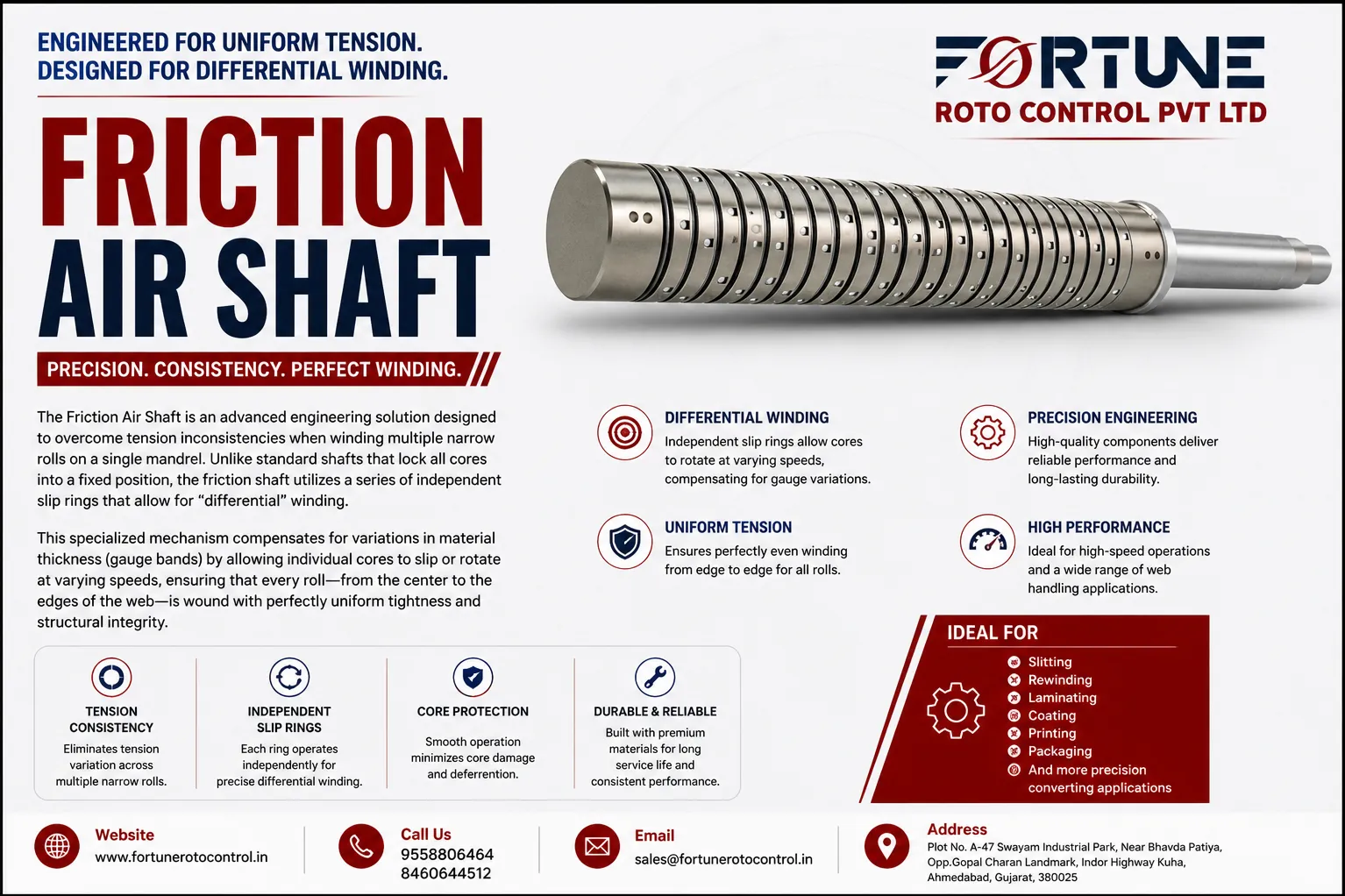
A Friction Air Shaft is specially designed for slitting and rewinding applications where multiple cores run on a single shaft and equal tension is required on each रोल. It is widely used in industries like BOPP film, paper, foil, laminates, and flexible packaging where thickness variation between rolls is common.
The shaft works on a combination of air expansion and friction-based torque control. It is fitted with friction elements or rings that expand when air is applied, gripping each core individually. Unlike a standard air shaft, it does not rotate all cores at the same torque. Instead, it allows controlled slipping between cores, so each रोल can adjust its tension automatically. This ensures uniform winding even if material thickness or width varies.
In real applications, this is very useful in slitting lines where multiple narrow rolls are produced from a single jumbo roll. Without a friction system, some rolls may become tight while others remain loose. A friction air shaft solves this issue by balancing the tension across all rolls, resulting in better रोल quality and fewer defects like telescoping or loose winding.
Operation is straightforward—insert the cores, apply air pressure, and the shaft expands to grip them. During running, the internal friction mechanism manages torque distribution. Releasing air allows quick unloading of finished rolls, reducing downtime.
Overall, a friction air shaft is a practical solution for converters who need consistent tension control, better winding quality, and smooth performance in multi-roll slitting and rewinding operations.
The shaft works on a combination of air expansion and friction-based torque control. It is fitted with friction elements or rings that expand when air is applied, gripping each core individually. Unlike a standard air shaft, it does not rotate all cores at the same torque. Instead, it allows controlled slipping between cores, so each रोल can adjust its tension automatically. This ensures uniform winding even if material thickness or width varies.
In real applications, this is very useful in slitting lines where multiple narrow rolls are produced from a single jumbo roll. Without a friction system, some rolls may become tight while others remain loose. A friction air shaft solves this issue by balancing the tension across all rolls, resulting in better रोल quality and fewer defects like telescoping or loose winding.
Operation is straightforward—insert the cores, apply air pressure, and the shaft expands to grip them. During running, the internal friction mechanism manages torque distribution. Releasing air allows quick unloading of finished rolls, reducing downtime.
Overall, a friction air shaft is a practical solution for converters who need consistent tension control, better winding quality, and smooth performance in multi-roll slitting and rewinding operations.
Keywords